It seemed a whirlwind of preparation that last week, and then we were off on Dec. 19th.
Bob and I used United 'miles' to get as far as Frankfurt, via Toronto and London. We did have a nice day in London, where we took in a theatre production and tried to get a good nights' sleep before meeting up with Ian and Allison in Frankfurt the next afternoon (they flew direct from Denver to Frankfurt). We had a nice meal together and walked around the Frankfurt outdoor Christmas market in the old city, had a cup of mulled wine, listened to some music and got in one more good sleep before the long trip to Delhi the next day.
How can I begin to describe India? Despite its growth as a recipient of US technology outsourcing, it is still one of the poorest countries in the world, with extremely uneven infrastructure. While Bob had been to India three times prior to this visit, it was the first time for Ian and I, and I will admit to some culture shock those first couple of days. One example that stuck in my mind was when we were, on the first day, driving out from the Delhi airport along one of the major highways to the south. There was major construction along part of this road to lay in a new water/sewer system. There were many large, round, cement culvert pieces sitting along the road and in the median of the road, awaiting the construction crews to get to that section of the road to lay them into the ground. Meanwhile, some people had moved into to these sections of culvert, and were using them as housing.
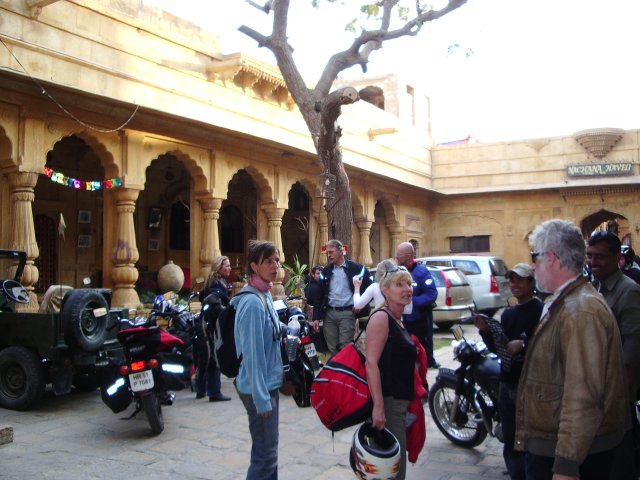
That first day, we drove south and west into Rajasthan on an all day journey that took us to a small village called Mandawa, where we arrived well into the evening, cold and tired, to a lovely hotel, improbably located out in the middle of the desert. Now here's where I must admit to the major part of this journey that we did not tell you in advance. It was at this hotel that we picked up our motorcycles. The entire rest of the journey was done on two wheels... up until the last day. We knew you would worry more than you already did about our well-being, so we decided to wait until after the fact, to give you "the rest of the story."
This trip was a true and exciting adventure for us, and not for the faint of heart, to be sure. India by itself challenges most Westerners emotionally, unless they have no social or political conscience at all. This is the more true when you do a lot of interacting directly with everyday Indian people in cities and villages, which we did, often thanks to Bob's ability to speak Hindi. Then there was the learning curve of the motorcycles themselves and the Indian traffic and roads, but more on all that in a moment. On top of that, we were with a very international group (mostly Germans, two Swedish, one British), six women and ten men, with interesting dynamics. The four of us were the only Americans and everyone else on this trip had questions and concerns about US politics and motivations. While we did our best personally to be gracious, participatory, open, and very much NOT "me first," I must honestly tell you that our national image abroad is extremely poor and Europeans (as well as educated Indians, Turks on airplanes, etc.) are not shy in letting us know it. I tried to speak as much German as possible (and managed to get some good German language lessons from a couple of the people on the trip) to avoid the impression that Americans are too insulated or too arrogant to learn any other languages and I hope that helped in some small way. All but one of the others spoke some-to-quite-fluent English and were interesting, well educated people. We ranged in age from Allison at 19 to Gunnar Soderstrom (Swedish) at 60, a retired, wealthy, mechanical engineer whose hobby is motocross cycle racing.
The tour guides were a 40-something couple from Germany who live part of the year in the Indian state of Goa, southwest of Bombay. They were good, if not great tour guides, lively people, and considerate of all of us. They did speak good English, which of course they would have to do in order to be tour guides in India. They also were excellent riders, with a lot of motorcycle experience, and their riding confidence rubbed off on me personally a great deal, and was a huge help throughout the trip.
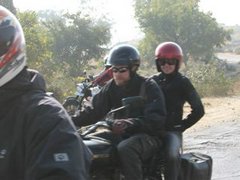
So we started our trip with short riding session to try to get used to the bikes, Royal Enfield "Bullets." These were 500cc, one cylinder, four stroke little bikes... very durable, but with their own learning curve. They are no longer made by Enfield in England [same as the small arms company in England], but come in three sizes in India. Ours were the largest motor they make and, for their size, they had great low end torque which came in handy going around trucks and buses on the roads. The initial difficulty with these bikes is that the gear shift is on the right instead of the left as we are used to on American and Japanese motorcycles, they have a kick start ignition instead of a push-button, and there is no little green light to tell you when you are in neutral, which of course you must be before kick-starting. It took me several days to get the hang of finding neutral and successfully managing the kickstart, which was a kinesthetic skill not related to strength or size, but did have it's own trick. I had to have Ramesh, our head mechanic, start my bike for me inumerable times, and he and Aslam, the other mechanic, were very proud of me when I finally was able to reliably start it on my own. Ian and Bob had fewer problems, but they were able to do the kick while straddling the bike and standing on one leg, whereas I was too short and had to start it with the kickstand down, not sitting on the bike. Also, the seat was a couple inches too high for me to "flatfoot" the bike, but I learned after a few days how to deal with that in most situations. By the end, the right foot shifting became very natural and I have a great respect for the durability of these tough little motorcycles.
Motorbike is a great way to see a country (although I also like walking tours for similar reasons). Much more up close and personal than from the window of a tour bus, especially as we stopped for tea and lunch breaks in the same places that regular Indian people eat. Indian villagers were friendly and curious, and very open to speaking with us. Bob's ability with Hindi allowed us to find out a little more about their lives than otherwise, and often we would have a crowd of the unemployed, the retired, or the very young surrounding us all talking at once. They wanted to shake our hands, find out "From which country do you come?" "How do you like India?", touch our motorcycles, have us take their photo, etc. (By the way, if you go to India, take a box or two of cheap pens. All the children asked us for them and we had unfortunately not brought any. I could easily have given away a few hundred pens!)
The total trip was close to 2000 Km or 1300 miles. We averaged 100-150 miles per day with several planned stops per day, and often a few unplanned ones. Our luggage came in the company chase bus with our mechanics, spare parts and tools. They went everywhere with us and I have to tell you that these guys were incredible mechanics. They could, and did, fix a fuel line, change a tire, take apart a motor and put it back together, or whatever else had to be done, in record time and with a smile and good heart. They were our back up support team and made us all feel safer and more confident.
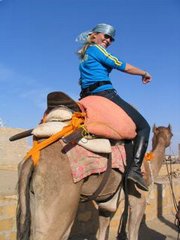
We visited all the most interesting cities and villages and sights in Rajasthan as well as little villages barely on anyone's map. It is largely a dry plateau, but has dunes, mountains, lakes, and the long and interesting history of the Rajput and Mougul Empires. In fact, most of the hotels we stayed in were converted palaces of Maharajas who were stripped of privileges during the administration of Indira Ghandi and had to find another way to support themselves than on the backs of the peasants. These buildings were beautiful and often amazingly restored. I felt like a princess to be staying such hotels, surrounded by villagers living one-room huts. India's contrasts are startling. We visited such cities as Jodhpur, Udaipur, and Pushkar, visiting fortresses and temples and other sites. But my favorite hotel was a restored fort on a high plateau in the mountains in the village of Bambora, surrounded by rice paddies and water wheels, and adjacent to a small and very friendly village where we managed a guided tour by a couple who were the hotel musicians. They spoke no English, but were gracious and happy to show us their little town. The woman helped me to purchase some lovely sari fabric and made sure I got a good price! We watched to sun go down that day over the hills from the rooftop terrace of the hotel, while sipping Indian spiced tea. Our room there was so beautiful it made me feel like a Maharani.
Indian roads. We rode on every possible type of surface from four lane highways to sand and gravel lanes and trails, rutted and potholed dirt, through streams, and on tiny mountain roads with endless switchbacks. Needless to say, I feel that I am a much better and safer rider than when we started. I think Bob and Ian would say the same. I was scared some days 100 times but I believe new learning curves keep you young and new experiences keep you alive and aware. I would not have missed this trip for all the tea in India!
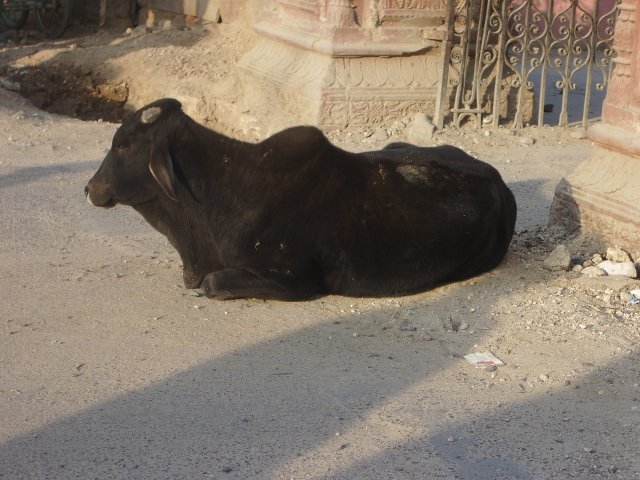
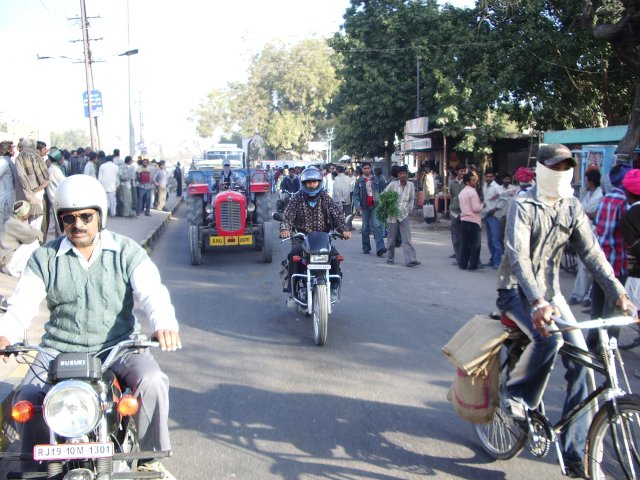
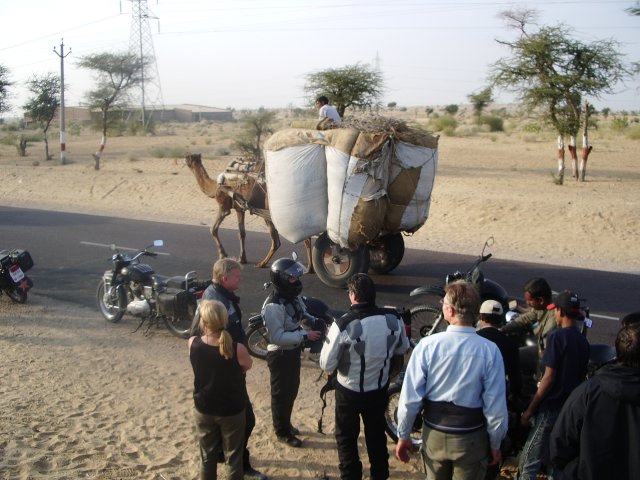
Then there was the Indian traffic. We almost always came to whatever town or village where our next hotel would be at rush hour, but we also passed through villages and towns and large cities every day. The traffic in an Indian city defies explanation if you have never experienced it. The roads are crowded with every type of vehicle from bicycles to 3-wheeled taxis, to carts and wagons, large trucks and buses. As if that were not challenge enough, there are just as many pedestrians as there are vehicles, as well as dogs, pigs, goats and sheep wandering the roads, water buffaloes and camels pulling imbrably huge loads, and, of course, the ubiquitous cows, which are everywhere and usually not tethered. All of these are moving at their own speeds, weaving and flowing in an unfathomable dance that defied logic much less traffic rules. There were rarely traffic lights and the driver or rider with the loudest horn wins. This was, for me, the greatest challenge because you were going slowly, up and down shifting every few seconds, and needed 360 degree vision. It was a sort of moving meditation or tai chi and I think most of us felt a certain small sense of triumph when we all arrived at the next destination without having run over anyone or gotten lost from each other!
Ian deserves special kudos on this trip, because he did all of thr above with a passenger on the back of his bike and he rode very, very safely and well. [BTW] He called us today from Istanbul (Jan 16), where he and Allison are having a wonderful time visiting a college buddy of Ian's and are slowly en route to school in Barcelona, which runs from Feb 6th to March 4th.
After 14 days on two wheels we arrived at the city of Bharatpur, where we bid farewell to the bikes and our back-up crew and met the bus that would take us to Agra, the city of the Taj Mahal. Hopelessly touristic, but undeniably one of the worlds most visually stunning structures, it is the story of the Taj that, perhaps, impresses most. Built by an emperor in memorium of a beloved queen who gave him 14 children, he watched the completion of the building from a prison cell after being deposed by his son. Today, he and his queen rest in the crypt below the main floor. We spent a couple of hours just wandering the gardens around the building and enjoying its visual harmony, which for me had the impact of both calming the mind and touching the heart.
That night we returned to Delhi and said goodbye to the companions who had accompanied us on this intense and fascinating experience. We are definitely still internally processing this trip and we will be for many weeks and months, I think. It was unlike any adventure of my life.


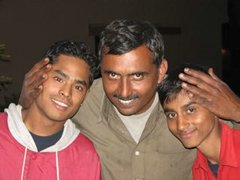 right, Ramesh, Alsma, and Monton. Photo: Tanja Kisker
 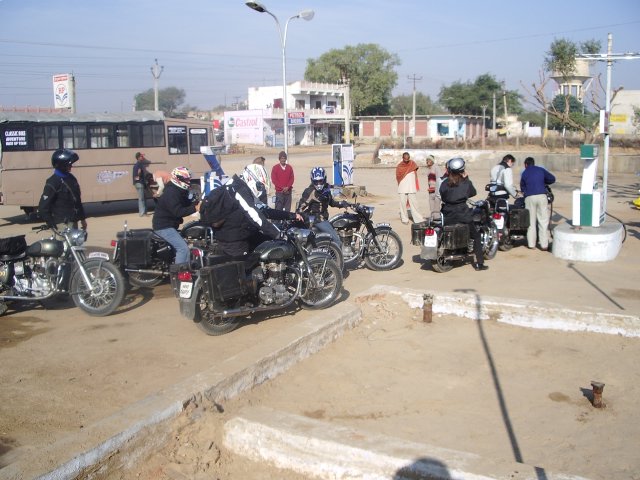 The morning gas-up ritual. Photo: Markus Maier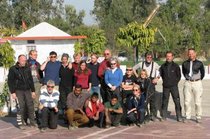
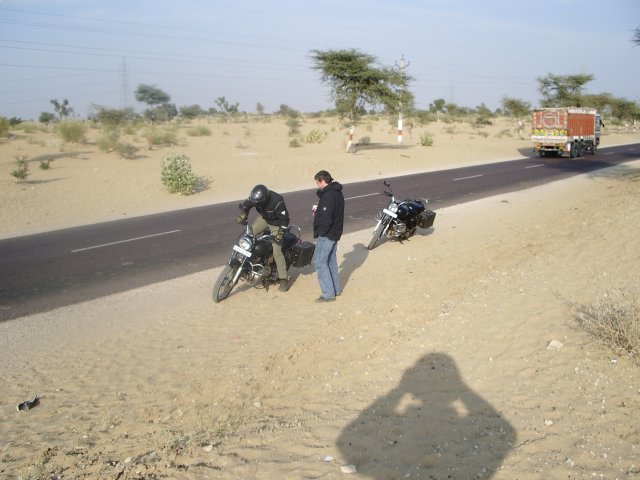
 und a hundred times per day.